Monday, March 17, 2008

Patagonia-Wild Refuge Under Attack


The International Rivers Patagonia Campaign has launched a new internet action to protest the HidroAysén proposal to dam the Baker and Pascua Rivers in the Aisén Region of the Chilean Patagonia. Go to this 3 minute slide show to get a glimpse into the campaign (and to see a few of my photos from the Pascua Expedition Project!). From the slide show you can link easily to the internet action. This is meant to be spread far and wide, so please do distribute.

For more information browse past vozsilvestre blogs just below, or follow the International Rivers link to the right.

As a sidenote, our famously small and well connected organization Ancient Forest International has recently joined the Consejo de Defensa de la Patagonia. It is an honor to be among dozens of other international and Chilean organizations working to protect the wild rivers of Patagonia.

Defendamos La Patagonia Carajo!

Wednesday, March 12, 2008

¡Viva Los Cedros!


El futuro de Los Cedros no está seguro!


Pero Los Cedros sigue siendo precioso!


¡Viva Los Cedros!

The rain was coming down hard, and it was one of those bus rides where the windows were so fogged up on the inside that it was impossible to see what was happening on the outside. Nonetheless, with the rain and the darkness of the fast approaching night, it may have been difficult to see anyhow. What is more, no hubo luz, there was no electricity in the small and desperate looking buildings. Perhaps than it is understandable that I missed the stop in Chontal and ended up traveling to the next stop on the new road along the Guayabamba River.

Ay, la gran p**a, me equivoqué! I should have gotten off in El Chontal, but the immense friendliness of the people in the northwest corner of Ecuador became immediately obvious. Getting off in Magdalena Baja (which twelve years ago was not even an actual town!) was made easy by a young local who showed me how to get to the Hormiga Verde and arrange lodging for the night. As well, I was actually better positioned to make the hike up to Los Cedros the following morning, using the well established mule trail that I had hiked so many times before. The road and electricity and phone were all new since my last visit twelve years ago, but some things had not changed that much just yet.

Twelve years! Twelve years come and gone. For all the traveling that I have done, and the many trips I have made back to places that I have worked and adventured, it is still remarkable when I return to a place that I have known intimately before. The Bosque Protector Los Cedros (previously the Reserva Biológica Los Cedros) is easily one of the most beautiful and inspiring forest landscapes that I have ever known. Twelve years ago, following the guidance and motivation of friends and colleagues, I ended up in Los Cedros working as an all-purpose volunteer. On that first trip to South America I spent the better part of 6 months up in Los Cedros, a protected forest area that borders the famous Cotacachi-Cayapas Ecological Reserve. Los Cedros is a classic private conservation initiative (that now enjoys a unique public-private partnership due to ongoing difficulties in securing land title) in the buffer zone of a globally important protected area. Birdlife International rates Los Cedros as one of the most important private conservation efforts in Ecuador. And finally, twelve years after my volunteer stint, I was returning to visit, pay tribute, and measure the changes to the reserve and the area.

If there is one thing that is certain, regardless of the slow pace at which change in the area around Los Cedros is occurring, it is that change is happening. The pressure is on all around Los Cedros, the pressure of illegal logging, the pressure of forest clearing for grazing and agricultural activity, and the looming pressure of large scale copper mining (see some of the coverage in Upside Down World for detailed accounts of the Ascendent Copper mine issue). Yet Los Cedros retains its wild essence, and continues to be a remote and spectacular ecotourism and rainforest conservation science destination.

Los Cedros will not always be as remote as it has been. The hike up to the reserve is famously grueling, with about a thousand meters of elevation to be gained on an often times extremely muddy and hammered livestock trail. Yet the road is being punched in to Magdalena Alta (the miracle in my mind is that twelve years later the road has not yet actually arrived to Magdalena Alta!) and there are more and more people living in the area, including potential squatters up some of the more difficult to reach drainages that pour out of the western extremes of the 6000 plus hectare protected forest. What is more, the threat of large-scale copper mining in the region is real, with untold potential negative impacts on forest and wildlife conservation in the area (without exploring potential social impacts).

I am fortunate to have had experience in Los Cedros. My time there previously was special, before the age of widespread Internet and cellular phones, and allowed me to develop an intimate relationship with the cloud forest and the submontane tropical rainforest that cloaks the steep and mountainous terrain of the Chocó region, the wettest and most diverse rainforest region in the Americas. I was once two months up in Los Cedros without coming down, one of my more extended periods in wild country, period. Such experiences are unique, and unrepeatable. Perhaps my brief visit now is tame in comparison, but I am thankful for having motivated to get back up to Los Cedros and reigniting my passion to support this project.

Speaking of supporting this project, there are three people that I want to thank here, for their dedication to Los Cedros and for their wonderful ability to instill in me a commitment to working for the long term care of this place and important conservation effort.

I want to thank Tim Metz for his long-term willingness to literally put his money where his mouth is. Tim is perhaps the single most important benefactor to the Los Cedros project, and I admire and appreciate his willingness to make Los Cedros a success.

Murray Cooper deserves appreciation for giving such an aesthetic touch in the development of the facilities at Los Cedros. Murray is probably the one person who put Los Cedros on the global tropical rainforest conservation map, and is the person who showed me the way to get there.

And last, but certainly not least, I want to give props to José DeCoux, the live-in guardian of Los Cedros, the man who got the whole project up and going. José is a madman, an expatriate rainforest dweller who has committed himself in profound terms to Los Cedros. His staying power and presence is what most has kept Los Cedros in the largely pristine state that the reserve still celebrates. It was great to make contact with José again during my visit, and I truly do aspire to contribute positively to the ongoing stewardship of this tremendous forest protection project.

¡Viva Los Cedros! It is our favorite forest protection project in the world! No one with an eye for wild country who makes the trip to Los Cedros can avoid falling in love with the place. My love for Los Cedros has been rekindled, and my amateur photos will only shine a weak light on why it is that we love Los Cedros so much. The birds, the flowers, the grandeur of the forest, the ability to drink of the freshest water in the Andes directly from the river, these are the qualities that we celebrate and that we continue to strive to preserve.

Feel free to join us in our efforts to make Los Cedros a continued success, contact me through this blog to support the legal defense fund and the infrastructure work that will allow Los Cedros is to achieve its goals in the next twelve years, just as the project has had so much success in the last twelve years. At the very least, if you are going to Ecuador make Los Cedros an essential stop on your visit. You will be glad you did.


Thursday, March 6, 2008

Todos Van al Oriente Para Trabajar


The infrastructure in Ecuador is chaotic. The roads, the water systems, the electrical systems, even phones and the internet, they all seem to be in terrible disrepair. Thus far I have not really had the time I would like to have to be online putting together full posts about my latest research and travel experiences. Soon I will present some thoughts on comparing Patagonia with Amazonía. The development issues are distinct, yet the similarities and the lessons abound. The Amazon is under serious stress, and it only demonstrates that Patagonia is still a remarkably intact region.

What might happen in Patagonia with hidroAysén is hinted at by oil development and unregulated colonization in the Amazon.


Though I have many ideas to share, for now I can only post some photos from my recent trip to the Shiripuno region of the Gran Yasuni, specifically the Territorio Étnico Huaorani.


Suffice it to say that if pictures are worth a thousand words, these current images of the Amazon should speak a great deal of how yes, human kind is wrecking havok on wild South America, even as the beauty still expresses itself wonderfully day after day.


More soon, after I return from our favorite project, la Reserva Biológica Los Cedros. First though some last images from the wild Amazon!


Monday, February 25, 2008

HidroAysén—Un Tema de Dinosaurios y Dinamita


The following is a short piece that I composed upon leaving Chile after nearly two months of traveling and working in that country on efforts to protect wild rivers in Patagonia from massive hydroelectric development. In my compositions I seem to always run the risk of serious hyperbole, a tendency that my colleagues thankfully point out to me right when I need to hear it most. Nevertheless, I share this piece here as another short item that attempts to paint a picture of the old-school ignorance that drives the push to destroy the largest rivers in Patagonia for short term profit and monopoly dominance of a society and its landscape. Chile is at risk of committing an irreversible error that will benefit only a very select sector of society, an error built upon dinosaurs and dynamite. It does however seem that our efforts to celebrate free flowing wild rivers, as hyperbolic as they might be, are having a positive impact. Regardless of the lawless and brute force with which the proponents of hydroAysén push forward with the project, the reality is that the company is already postponing the submission of their project to Chile’s system of evaluation of environmental impact and that Chilean society is steadily awakening to the audacity and barbarity of the proposal. In that light I have to say that my visit to Patagonia was effective and that our campaign is bearing fruit—stay tuned here for more updates as the issue evolves over the next months. In the meantime, enjoy the hyperbole and wordplay that I have published below.

Existen lugares que nos hacen pensar en el largo del tiempo. No es el largo del tiempo de nuestras vidas, ni de nuestras sociedades, pero el largo del tiempo de los milenios, de las geologías, de los movimientos de las tierras, y de las adaptaciones de las evoluciones. De vez en cuando nos encontramos en lugares del largo del tiempo en los cuales podemos hasta imaginar que pasarán dinosaurios frente de nuestros ojos. Otras veces son lugares donde no nos perdimos en juegos o fantasías de las maquinas de tiempo, pero sí donde nos distraemos del presente en sentir la fuerza del pasado y hasta revivir las épocas de los dinosaurios. Son lugares que nos regalan una sensación de un pasado lejano, de un antecedente que tiene que ver con nuestra realidad pero que ahora no es nuestra realidad presente mucho menos de nuestro futuro. Sin embargo, sabemos que la trayectoria del tiempo que sentimos en éstos lugares tiene importancia, es relevante y nos ofrece perspectiva sobre nuestras vidas y la expresión de nuestra humanidad dentro del contexto de los cambios elementales y el tiempo.

Por mí, llegar al Río Pascua fue llegar a un lugar que me hacía sentir el correr de los tiempos, desde un pasado casi imposible imaginar, hasta un pasado tan reciente que ni importó cuanto intentaba olvidármelo, siempre me estaba presente. Metafóricamente, el corriente en común fueron los dinosaurios, los dinosaurios reales de los comienzos del tiempo y de los dinosaurios fantásticos perdido en el pasado. En el Río Pascua pensé en los dinosaurios en términos de los continentes originales, en términos de seres que ya no pertenecen a nuestra realidad, y en ciertos individuos cuyos formar de pensar es de antigüedades y encuadradas maneras de contemplar el presente. Pensé en los dinosaurios que existieron como parte de la evolución, que aunque se extinguieron también fueron parte del milagro de la creación. Y pensé en los dinosaurios de hoy en día, que son seres perdidos en un pasado y que por algo inflexible en su composición se nos llevan rápidamente hasta una nueva época de extinción.

La cuenca del Río Pascua es una de las cuencas hídricas menos conocida en todo las Américas, y es probablemente el río menos conocido y más silvestre de Chile. Nacido del gran Lago O’Higgins (conocido como San Martín en Argentina), el Río Pascua es de relevancia continental y global, y es esencialmente el gran corriente de agua que baja desde el borde norteño del Campo de Hielo Patagónico Sur hasta el Canal Baker y luego al mar abierto. Véalo en su escala física real y lo verás en su escala de tiempo también. Es majestuosa, es expansiva, es poderosa, el Río Pascua es uno de los pocos ejemplos que nos quedan intactos en Chile y en el planeta para completamente entender la escala de vida en nuestro planeta y del milagro que es la creación y el correr de los tiempos.

El Río Pascua es nuevo y antiguo, todo a la misma vez. La cordillera va creciendo del mar y ha cambiado mucho en los últimos milenios, pero también el antiguo continente del Gondwana está presente. Quizá hace poco que el hielo dejó de cubrir esta roca dura que es el fundamento de la topografía difícil de la cuenca, pero hace mucho que la evolución ha tenido su dominio sobre esta tierra. La cuenca del Río Pascua es prístina, tiene intacta las relaciones ecológicas del ecosistema prehistórico y mantiene un alto valor biológico por la presencia del complejo de las especies nativas y la ausencia de impactos de las actividades humanas. No existe una manera de intervenir en el paisaje de la cuenca del Río Pascua en una manera industrial sin acabar con su característica silvestre y auténtica. Se habla de una utilidad de unos 50 años cuando se habla de las represas de hidroAysén, pero la cuenca del Río Pascua es una cuenca en la cual 50 años es una gotita de tiempo que casi no se medir por ser tan pequeño frente de su grandeza y trayectoria elemental. Que son 50 años frente del milenio que lleva el agua de correr desde el campo de hielo hasta el mar? La posibilidad de realizar una serie de mega proyectos hidroeléctricos en la cuenca del Río Pascua sin destruir su valor ambiental es un mito fantástico nacido en los escritorios de los profesionistas de las empresas de relaciones públicas, gente que tiene ningún vocabulario ecológico, dando luz a una fantasía igual a las películas de dinosaurios como el Jurassic Park. Hablar de mitigar impactos al represar el Río Pascua es confundir la explosión de dinamita con el trueno del ventisquero—y viene de una mente que sufre de un analfabetismo ambiental.

La realidad de la propuesta de hidroAysén es una realidad explosiva. Si hay una cosa que se tendría que utilizar para represar el Río Pascua es la dinamita. Mucha dinamita. Toneladas y toneladas de dinamita. No es posible mitigar la destrucción necesaria para construir caminos, túneles, y represas en una cuenca prístina. La dinamita no es un proceso natural como el ir y venir de un glaciar. Es una destrucción total, la conversión de un lugar que trasciende el correr del tiempo hasta ser una zona de sacrificio industrial. En términos ambientales no hay como mitigar los impactos de la propuesta. El concepto de mitigar los impactos ambientales de intervenir en el Río Pascua es una mentira y una propaganda de pura fantasía.

Son dinosaurios fantásticos ellos que proponen la destrucción del Río Pascua. Son dinosaurios los Mateo, los Perez Yoma, los Pizarro (que increíble pensar que los criollos Chilenos ya quieren regalar su independencia a los españoles conquistadores, no?), los Angelini, y los Matte que proponen a Chile y al mundo que la solución a los desafíos energéticos y económicos de Chile queda en la intervención masiva en los Ríos Baker y Pascua. Son mentes fundamentalistas que solo piensan en sus cuentas bancarias del corto plazo, y que necesitan de las grandes firmas de relaciones públicas para disfrazar su propuesta destructiva y analfabeta ecológica de utilidad pública y factibilidad ambiental, por que sin inversiones gigantescas en publicidad sus ideas no podrían ni ser considerados razonables debido a la ausencia completa de justificación social y ambiental.

El tema de la propuesta de hidroAysén es un tema de dinosaurios y dinamita. Los dinosaurios pueden ser reales y pueden ser fantásticos, pero la dinamita que quieren usar para destruir los ríos patagónicos es de verdad, y es muy explosiva. Solo los que tienen una mente vacía y obsesionada por su poder y su dinero pueden seguir ciegos a la destrucción y irresponsabilidad que sería intervenir en los paisajes únicos de la Patagonia y meter un cuchillo en la cultura libre de la región de Aisén. Chile queda al borde de cometer un error que es irreversible y que va a revelar al mundo la poca sofisticación que tiene la alta sociedad chilena en permitir esto tipo de barbaridad en el siglo 21. Dinosaurios y dinamita son los dos ingredientes primarias de la propuesta de hidroAysén—nos queda ver si Chile los traga entera o si se despierta en buena hora para defenderse de una propuesta explosiva y destructiva.

Friday, February 8, 2008

Río Pascua: El Secreto Ya No Es Un Secreto


For more of my photos try this slide show at Picasa.

El Secreto Ya No Es Un Secreto.

The Secret Is Out.

The company was betting that the world would not discover what they were up to in the hidden recesses of Patagonia. Yet we beat the odds and pulled off a great adventure, with plenty of adversity and uncertainty included. We made the Río Pascua trip in good style, though it turned out to be a bigger landscape than even I had thought it would be. We pushed hard to get our people into this area of conservation concern. I was thorough in the preparations and intentional in the leadership, everyone came together as a great team, and we had a safe and successful wilderness journey. And now we know what the company did not want us to know. We now know intimately a landscape that is a marvelous ejemplo del alma de la Patagonia Rebelde, y ahora vamos a gritar al mundo la noticia!

The Río Pascua is a jewel! The entire upper stretch of the watershed that we explored is pristine, wild, and incredibly intact—a rare example of native Patagonian mountain and river ecosystem that has not been subject to heavy grazing pressure or other extensive human activity. The landscape and the elements have conspired to protect and to isolate this watershed from cattle and human settlement, even on the basis of seasonal use. The ecological value of this watershed is high, due to what is present, and due to what is not present. There are very few, if any, invasive species throughout the stretch of the watershed that we explored. This roadless and wild watershed is a seed for restoring life—es una semilla en forma de ecosistema, necesario para restaurar la vida; to industrialize it is to further sentence Patagonia, and perhaps all of the Andes, to a future of steady degradation.

I speak of a river, but I also speak of a mountain river. I speak of an Andes mountain river that is born of a mammoth lake and that pours rapidly, steeply, and strongly to the ocean. Las aguas del Río Pascua llevan con su fuerza el nacimiento de la tierra y el alimento del cielo, y hasta el cielo fuimos. We were forced high. The topography is rough and steep. The vegetation near the water level was always thick and thorny, with sudden cliffs and overhung forest of mosses and groundcover. Crossing the Río Quiróz was the most athletic step of the trip, sin René Millacura quizá no lo hubieramos cruzado. Yet we crossed, we worked hard and we continued traveling and marveling at this wild jewel of a river pouring from the glaciers of the Patagonia Continental Ice Field.

The weather was with us, though the sun burned and was unforgiving. We were fortunate in some ways, the dryness of the conditions being one of them. The marshy soils, and especially the one extensive mallín that we were forced to cross, were easily managed and hardly as challenging as they might be to a group of our mixed strength and experience. Certainly a real Patagonia rain may have stopped our group in its tracks, especially above the tree line—but we were not destined to experience such misery. Instead we stepped high in stable conditions and skirted the depths of the tight canyon through which this voluminous and majestic Río Pascua roars.

The high country treated us well, it was physical but we had a stellar night of alpine camping and finished the next morning with a panoramic summit with stunning close up views of the Southern Patagonia Ice Cap. We could sense the Pascua pulsing below us, we could literally feel the power of the ages that had passed in the carving of that deep valley, carved drop by icy drop of glacier fed water. To attempt to dam such a river would be to knife the heart of the extensive wildland that stretched out around us in a 360-degree view.

Proposing the construction of three big dams on the Pascua was not supposed to draw the attention of anyone, but it certainly caught the attention of our diverse crew of wilderness loving souls. Were we just supposed to stand by with our eyes squeezed shut, pretending this was not happening? La cuenca del Pascua aún tiene la essencia de lo que es la Patagonia Silvestre. Es un refugio nativo y antiguo, de los huemules, de la vegetación, de los agues dulces de los hielos sureños. To destroy this remaining jewel of Patagonia is to reduce the human endeavor to one of brute ignorance. Only one who is completely unable to sense the strain that our native ecosystems are experiencing would be barbaric enough to consider destroying this watershed.

Quiere usted que yo lo diga en el castellano? Entiende usted que es una estupidez anti-intelectual pensar que ustedes van a resolver la crisis ambiental-energético con una intervención grave en el corazón de la tierra que nos sostiene?

A sincere mountain traveler has ecological literacy and environmental sensibility in their bag of tricks. Anyone who calls him or herself a montañista will be able to recognize special qualities in a place, and will be able to tune into to the state of conservation of the flora and the fauna. The Río Pascua flows out of a giant ice field and a very important national park, and borders a new Biosphere Reserve area. Without even questioning why this jewel has been left out of previous protected areas strategies, on the pure basis of essential biological connectivity and native habitat quality it violates all sense of conservation science (and corporate responsibility) to propose violating this nucleus of untrammeled nature with a massive industrial hydroelectric project. A hippy, a montañista, a responsible business man knows full well that they have no environmental justification for dynamiting canyon walls and pouring concrete into this free flowing river in order to continue wasting energy more than 2000 kilometers away. It boggles the imagination that a man who claims to be close to nature would propose such sacrilege.

No Matte a La Patagonia! Absurd, yet the slogan is quite hilarious, and very much to the point. Esta es una oportunidad única en la historia, usted puede mostrar un liderázgo que es maduro como el instinto de un montañista verdadero. Stand down old man, your plan to represar los ríos libres de la Patagonia es mal pensado, ya es hora que admita usted su error y cambie de trayectoria!

Thursday, January 17, 2008

Sincere Thanks for a Patagonian Welcome


I have been so busy since I arrived to Coyhaique that I have not even had a moment to play with words and reflect on the project that I am working on. I do recognize, however, that I have lots of history in Coyhaique. I first arrived here back in late 2001, when I was a graduate student on the advocacy road, sending my first dispatches from the Carreterra Austral.

One difference between then and and now is that I have a better eye now, I am even more acutely aware as to the changes that are happening to Patagonia. I can sense the changes and for this reason I treasure the efforts of artists to document the authentic roots of the region. My friends and colleagues Milenka and Corey worked on a project that resulted in Milenkas must see online photo exhibit: pobladoresaustrales.com

These images capture the soul of what is Patagonia, the patience and weathering of the roots in the earth of the region. My dearest friends, I say please take a moment to go there and marvel at these fotos.

I have no photos to publish tonight, I have been running constantly to pull this trip together. It still remains to be seen how it will all play out. I wonder sometimes what logistical foul up I have put into place, or if somehow the tents won't actually work etc etc. But then I wake up and get back to work.

Here I am in Coyhaique, and here come the people tomorrow! Everyone eager to save the day! I love the great energy, we will be a ball of love and adventure in the face of HydroAysén and their disinformation campaign.

Save the day or not, I would not be able to be where I am in this project if it were not for the help of all of my friends at NOLS Patagonia. The community is great and the willingness to support positive efforts to celebrate free flowing and wild rivers here in Patagonia is inspiring. Thanks so much!!

I also have to thank all the people at the Coalición Ciudadana Aisén Reserva de Vida because it is their excitement about the trip that make all of this really worthwhile.

I also want to thank Hans Silva (carreterraaustralkm1240) for all his help getting things ready for us down in Villa O'Higgins. We are going to the very wild end of the road, and we want to let folks know why it is worth keeping it wild!

The hard work blurs my vision. I mix my personal preferences with the need for professional tolerances. Now however I am finally getting close to my purpose for being involved with this project. Wilderness provides such immediate feedback on leadership, of self and others. This is an incredible project because it is a campaign element that will contain many new revelations for those of us who think we know la Patagonia, that we know South America, that we know Chile. I am looking forward to some new lessons.

I am also looking forward to making a connection with a particularly wild stretch of burly andean river that is threatened by small minds pushing for damming and hydroelectric conversion. My mind is open to the possibilities that this trip provides for me, professionally and also personally. I believe I am about to deepen my personal relationship with the landscape of Patagonia, and I welcome that. Hopefully I can assist in an opening of doors for some of the others on our journey as well. Time for a chance to touch the earth.

Thanks and praises, wish us safe travels!!

Monday, January 7, 2008

Desde Oaxaca Hasta Aisén--Con Las Pilas Recargadas


It is highly likely that I would have spent time in México this winter, most likely working for the National Outdoor Leadership School in Baja California Sur as I did last winter. Nevertheless, there is very little possibility that I would have found myself working in Patagonia again this winter (even though colleagues at NOLS had inquired as to my availability) if it had not been for International Rivers approaching me about working as a consultant on their new campaign to protect rivers in the Chilean Patagonia.

Fortunate as I am, I find myself living the best of many worlds in Latin America. The work for International Rivers has enabled me to travel more extensively and incorporate a number of my personal interests into a winters travel that I was slowly motivating myself to organize.

Truly, I am seeing the best of many worlds. I just spent several weeks in México, mostly in Oaxaca and Guerrero, as well as México DF, working from a distance on the preparations for the Pascua Expedition Project for International Rivers through the miracle of the internet, and taking as well a needed break from all work, I repeat, ALL work.

There is nothing quite like time on the beach to get personal batteries fully recharged. It is humorous to contemplate how I have developed some fine beach skills over the last years. After all the time I invested in becoming a competent climber and skier, as far as outdoor activities go I now thrive on sleeping long hours and enjoying a good cold beer with my huevos rancheros and chilaquiles in the late morning hours before whiling away the day reading and swimming in the glorious waves and waters of the Pacific Ocean.

It was a well-needed break, and now I have a full battery charge for the next month of intensive work in Chile’s Aisén Region. I really do feel as well rested as I have in a good long time as I prepare to carry out the expedition that we are attempting. I am quite fired up for taking a good look at the remote and wild Río Pascua, one of the two major waterways threatened by ENDESA and Colbun’s proposal to build giant dams and destroy these free flowing rivers.

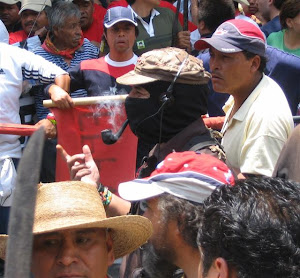
Yet before I immerse myself in Patagonia again, I want to share here a couple of highlights that stick out from my memories of the last couple of weeks. My time in Ciudad de Oaxaca was particularly powerful, considering the turmoil that has wracked that city and state in the last years. The repression and violation of human rights that occurred last November especially is very well documented in a publication that I read from extensively during my break from work—La Quinta Visita de la Comisión Civil International de Observación de los Derechos Humanos. A relevant piece of analysis concludes that Brad Will was purposely targeted by state government paramilitaries to force the United States government to come down on the Fox government to send in the Mexican federal police and break the social movement.

Oaxaca is to México a little like Guantánamo is to the United States—that dark side of a conservative power elite that many normal people are afraid to contemplate seriously due to the implications that the violence that has happened in those places means for our societies. How long do we look away?

I had one particularly intense moment in observing a white female tourist, obviously not Mexican, take photos of an old indigenous couple that implored to not have their photo taken. This woman encapsulated to me all the snotty and racist energy that has emanated from gringo tourists bemoaning the conflict in Oaxaca that caused tourism to be placed on a total backburner. While the older indigenous woman grabbed her husband by the arm, slowing his attempt to rise and confront the white woman that ignored their requests to not have their photograph taken, the white lady went ahead and snapped photos, oblivious to their pleas and the brutal rudeness of her own behavior.

It was all I could do to avoid confronting that white woman and tell her that her classist attitude and cultural ignorance encapsulated everything that people might hate about “Americans” from the United States. In that moment I understood why, perhaps in the heat of a mad demonstration that marginalized Oaxaqueños might find themselves unleashing in frustration at the impunity that the power elite enjoy, why there might be an urge to burn to the ground famous tourist icons. In that moment I hated the stupid white people of my country, as well as ignorant rich tourists from all over the world, in a way that I had not felt ever before, more profoundly than I could remember even in my most adolescent punk-rock anti-capitalist tirades.

I managed to walk away from that moment and catch my breath, just in time to let the overwhelming sadness kick in. A sadness knowing that underneath the aesthetic beauty of historical Oaxaca there still exists a sharp tension, a dream deferred, and the scars of political manipulation of a community’s psyche. Death squads and media broadcast death threats are not injuries that heal rapidly.

México is a place of contrasts. The other highlight that I want to mention was being spontaneously invited to participate in a Huichol ceremony a couple of nights before the new year. Estoy muy agradecido a nuestras colegas por habernos invitado estar con ustedes por esta noche tan especial. Estar presentado a las enseñanzas del Maracame de la sierra madre occidental fue un honor. Nunca me olvidaré de la música, el fuego, la ceremonia, y la luz del día que nos llegó después de tanto trabajo en una playa quieta de Guerrero.

Yes, my batteries are recharged, and with clarity I can see the whole of the next steps of work that lie ahead of me. Gracias maestro Maracame! Desde México voy hácia la Patagonia para celebrar sus ríos lindos y vivos!

PS. Tengo fotos de mi llegada a Chile en mi manyhues,gnn.tv blog, veanlas!

Friday, December 21, 2007

Voz Silvestre Blog Launch--Pascua Expedition Project


I have hardly had a free moment with my computer since I left my Northern California home. It has been all about working on my latest consultancy with International Rivers. The Bay Area was non-stop, and the trip to the Aysén Region is well on its way to becoming a reality. A crazy wild improvised reality, but a reality none-the-less.

This is definitely one of those situations where one wonders if they have bitten off more than they can chew. I know I feel like I am making a lot of this up as I go. Thank goodness for the help of friends and new colleagues. Otherwise I would feel like I was hiking straight into a hailstorm without knowing where I was going. At least this way I feel more like I know where I am going, though I am not yet sure I can tell when the hailstorm will hit. There is a big difference between those two feelings. Thanks to everybody helping make this trip happen.

What trip you might say? At the end of November I was approached by Aaron Sanger, now the Patagonia Campaign Coordinator at International Rivers, to lead a trip to the Pascua River drainage in the south of the Aysén Region of Chile. What started out as a consultancy to organize a low profile backpacking trip has turned into a major media production. It is increasingly obvious, though, that making a splash with our trip to remote Aysén is a key element to a rapidly emerging international strategy to prevent the industrial development of a remote stronghold of wilderness lore.

As one of the initial expressions of International Rivers’ new Patagonia Campaign, The Pascua Expedition Project is an effort to put an international light on the threats of mega hydroelectric development to Patagonia’s wild rivers. It is an urgent backcountry and environmental delegation to a practically unknown place that has been slated for industrial conversion. We aspire to backpack down the length of the main body of the Río Pascua, from its headwaters at the outlet of Lago O’Higgins, down to the road that is being punched into this remote area bordering the Southern Patagonia Ice Field. On this hike we should be able to get a first hand view of the landscapes in question and help answer the question of what exactly is at stake.

The Pascua itself is a short, steep, and high volume river. As seen is this map, the plan of HidroAysén is to build three dams on this river.

The damming of this river is definitely impressive to contemplate. We want to hike it and get to know it and document, as I have said, exactly what is at stake.

Getting this trip together is definitely turning into a big deal, We have had lots of help from folks in Patagonia, in Coyhaique and Villa O’Higgins, even considering the pressures of high season tourism on everyone’s time and resources. My goals are to have a safe trip, to be as low impact as such a campaign device might be, and to contribute to a growing chorus of people demanding that the HidroAysén Project be abandoned.

Take a look at some of the previous blogs I put up here, the videos and article that I posted are great background material on the HidroAysén project. This is a huge project, one that previously I was watching with concern from a distance, but that now I am awash in, as intensely and more rapidly than the campaign to stop the Alumysa project. Back to Patagonia, can you believe it? It really is like coming in off the bench. I am certainly not going to be a substitute for anyone, but the situation is serious enough that all the second stringers need to get on the field now too.

Monday, December 10, 2007

HidroAysén--a multiheaded monster unleashed on Patagonia

The preparations for my return to the Chilean Patagonia are well underway, and soon I will be in the San Francisco Bay Area pulling together more of the pieces of the puzzle for our upcoming trip down to Aysén. I will be sure to post a more detailed description of our proposed trip soon.

It seems that the effort to protect Patagonia's rivers is continuing to run head on into the monster of mega-industrialization. The following link leads to an important article, published just last week in a newspaper from British Columbia, which describes the scale of the potential impact of the HidroAysén project.

Interestingly enough, some of the same players who were pushing for the installment of the Alumysa aluminum smelter are behind the HidroAysén project. Notice in the article that Mr. Dennis Couture, who was spokesperson for Noranda/Brascan Corp while attempting to push Alumysa on Patagonia, is now spokesperson for the Brookfield (formerly Brascan--got to love the re branding strategies of exploitative industry!) economic group that wants to build the longest high tension power line in the world, fragmenting protected areas along the length of Chile's Patagonia. This on top of the five dams on two rivers that ENDESA and Colbún are proposing. A truly multi-headed monster come to consume the still free rivers of Patagonia. Read the article for an interesting and informative perspective into the project.

Canadian pension funds linked to controversial project in Patagonia

As well, para nosotros que hablan el castellano, hay otro video que es una buena resumen del monstruo de HidroAysén. Este video es de la campaña Patagonia Sin Represas.


Stay tuned to this page for a full description of the Pascua Expedition Project, a trip to one of the last unknown wild rivers of the Patagonian Andes, the Río Pascua, threatened by the HidroAysén proposal.

Thursday, December 6, 2007

Background Video on HidroAysén Dam Proposals in Patagonia

I am slowly getting my feet under me for pulling this new vozsilvestre Blog together, and for getting ready to travel back down to South America. Everything is happening very fast now, but the learning curve is in my favor it seems.

What I would like to share here are some short YouTube videos, one from Glenn Switkes at International Rivers and the other a little celebrity NRDC video with Beto Cuevas of La Ley, the Chilean rock band. Hay una versión en español del video de Beto también.

Both of these videos describe the threats to Patagonian rivers and landscapes due to major hydroelectric development. Take a look at these and learn some basics about the HidroAysén project that I will be heading down to check out more closely. Wish us luck!! And go ahead and take action with NRDC.